A Change of Frame Makes the Capture Point Proprioceptive: Distillation-Free Humanoid Single-Leg Balance
Abstract
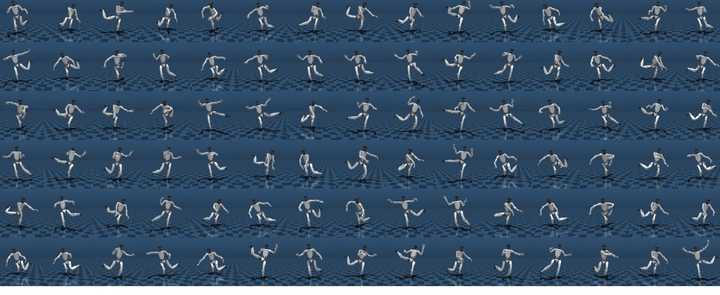
Unified humanoid policies track agile whole-body motion, yet few can hold a clean single-leg stance. On the single-leg balance benchmark introduced here, eight released state-of-the-art general policies hold a clean stance on none of 90 held-out motions; they stay upright only by hopping or re-planting a foot, recovering from imbalance rather than preventing it. Prevention needs the capture point, the center of mass (CoM) extrapolated by its velocity. That velocity contains the base linear velocity, which no on-board sensor measures, so the capture point has been confined to rewards and privileged critics and has reached hardware only through teacher–student distillation. A change of frame removes the obstacle: expressed relative to the support foot, the base velocity cancels identically, leaving a capture-point state reconstructible from joint encoders and an inertial measurement unit alone. We place this support-relative dynamic-CoM observation directly in the deployed actor and pair it with a reward library translated term by term from human postural control. Trained with asymmetric FastSAC and no distillation, the resulting policy, DDC, holds clean single-leg balance on 89 of 90 held-out motions across nine pose classes and runs directly on a Unitree G1; removing the observation alone costs 43 points, and 53 under deployment noise. We release the policy, the data, and a method-agnostic MuJoCo benchmark for humanoid single-leg balance, which scores any released policies on the same held-out motions. Together these turn single-leg balance from a per-task demonstration into a capability the field can measure and build into general policies.